Sparkler Audio: The Handmade Japanese Brand Most Audiophiles Have Never Heard Of
There are famous names in high-fidelity audio. Then there are the names that experienced listeners mention quietly, usually after you have heard their system and asked, “What is that?”
Sparkler Audio belongs in the second category.
Founded in Japan, built in small quantities and sold through a limited network of specialist dealers, Sparkler is almost unknown to many Australian listeners. That is not because the brand lacks history or ambition. It is because Sparkler has chosen a very different path from the mainstream: no mass production, no glossy showroom network and no race to add more features, more watts or more complexity.
Instead, its founder, Kazutoshi Tsukahara, has developed a compact range around a simple conviction: audio equipment should preserve the freshness, emotion and natural flow of music.
At Toma Audio, we think that makes Sparkler Audio worthy of a proper audition.
A Japanese workshop with an unusual lineage
Sparkler Audio was established on 1 February 2013 in Beppu, Oita, Japan. Today, it remains a small workshop exporting to more than 25 countries.
Its founder did not arrive at audio design by accident. In 2010, Tsukahara worked with the respected Japanese company 47 Laboratory, designing an FM tuner and CD player. He then established his own workshop, known as 47 Treasure, in Yamanashi in 2011 before formally founding Sparkler Audio.
That lineage matters. 47 Laboratory has long attracted listeners who value simplicity, unusual circuit thinking and an intimate connection between engineering and musical expression. Sparkler continues that spirit, but with its own distinctive approach.
The company’s stated philosophy is beautifully direct:
“Born from the heart, music must reach the heart.”
Sparkler’s products are developed and handmade in-house, without outsourced design or manufacture. The company deliberately avoids mass production and describes finishing each unit as completing a work, rather than simply manufacturing a product.
That is a bold position in an industry where many products are designed around scale, automation and cost efficiency.
The price-per-watt question
Let us address the obvious objection first.
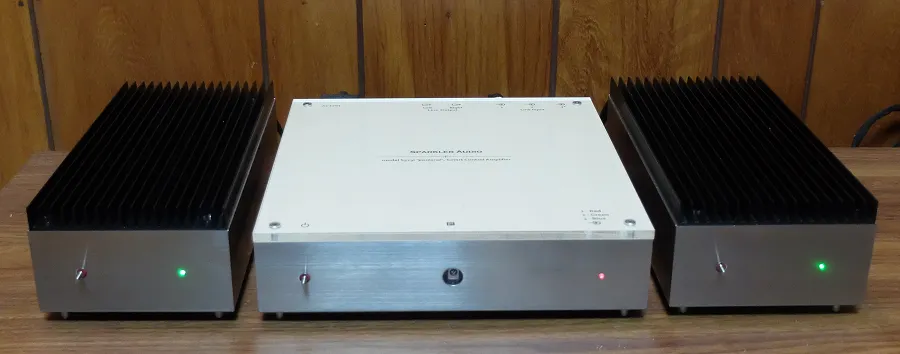
The Sparkler Audio S513i “pastoral” control amplifier and S514i “rhapsody” dual-monaural power amplifier pair costs $5,750.00 AUD at Toma Audio. The S514i delivers a maximum of 25 watts into 8 ohms.
Twenty-five watts for $5,750?
Judged purely by watts-per-dollar, that can look absurd beside a mass-market integrated amplifier offering 100 or 150 watts for considerably less. But watts-per-dollar is a blunt instrument. It tells you how much power an amplifier can produce, not how carefully that power is delivered, how cleanly the circuit behaves at normal listening levels or how naturally it integrates with your speakers.
Sparkler takes a buy once, buy well approach. The S513i and S514i are fully discrete, current-mode designs, built one at a time in a Japanese workshop with carefully selected semiconductors and no cost-engineered shortcuts.
The result is not intended to drive every loudspeaker in every room. That would be an irresponsible claim. Speaker sensitivity, impedance, listening distance and room size still matter.
But with a genuinely efficient, easy-to-drive loudspeaker, 25 watts can be entirely sufficient for a normal living room. More importantly, a small number of high-quality watts delivered without strain can sound more complete and composed than a larger amplifier spending most of its life idling.
In most homes, average listening levels use only a few watts. What you need is enough headroom for musical peaks, sensible gain structure and an amplifier that remains stable and untroubled when the recording becomes demanding.
The pairing matters more than the headline figure.
Current-mode signalling: the invisible backbone
The “i” in Sparkler’s model numbers identifies its signature current-mode signalling technology.
Most conventional audio equipment uses voltage-mode transmission. The signal is sent by varying voltage into a high-impedance load, typically between 10 and 100 kilohms. Current-mode transmission works differently: it varies current into an extremely low-impedance load, effectively 0 ohms.
Why does that matter?
External interference tends to induce voltage-mode noise. Current-mode signalling is inherently more resistant to that form of interference, helping the signal remain clean as it travels between components.
It also makes longer interconnects practical. The S513i control amplifier can sit with your source equipment, while the small S514i monoblocks can be positioned several metres away, directly beside the loudspeakers. That can simplify a room layout and shorten the speaker cable runs.
Think of the S513i as the traffic controller and the S514i monoblocks as the final delivery vehicles. The control amplifier manages the signal level and sends the music through a low-impedance current-mode connection. The power amplifiers then deliver it to each speaker independently.
Only one line input on the S513i is conventional voltage-mode. Sparkler converts that incoming voltage signal to current, after which the signal remains in the current domain.
Two small components with serious engineering inside
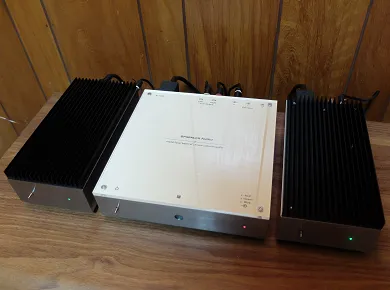
The S513i “pastoral” is a control amplifier with remote control. It uses a fully discrete, seven-bipolar-transistor linear current amplifier, with approximately 10 dB of current gain, or three times.
It provides:
- Two current-mode RCA inputs
- One conventional voltage-mode RCA input
- A current-mode RCA output for the S514i
- A proprietary 32-step electronic attenuator
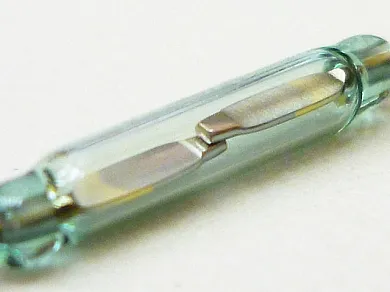
- Inert-gas-sealed reed-switch input selection
- Dimensions of 202 × 47 × 202 mm
- Weight of 1.8 kg
The volume control uses no mechanical contacts. Instead, Sparkler’s electronically controlled attenuator regulates the sending current in 32 steps.
Input switching uses sealed reed switches with ruthenium contacts. The inert-gas environment protects the switching mechanism, while ruthenium was selected for durability and reliable long-term contact. These details may sound small, but they form part of the invisible backbone of a high-fidelity system: fewer unnecessary contacts and fewer opportunities to compromise the signal.
The S514i “rhapsody” is supplied as a pair of monoblock power amplifiers, one for each channel. Each amplifier uses a fully discrete dual-JFET and nine-BJT, high-slew-rate design.
Its specifications include:
- Maximum 25 watts into 8 ohms
- Approximately 29 dB of voltage gain
- Frequency response from DC to 500 kHz at -3 dB
- Universal speaker terminals
- Dimensions of 102 × 60 × 202 mm per unit
- Weight of 1.8 kg per unit
The monoblock arrangement separates the channels physically. It also allows each amplifier to sit close to its corresponding loudspeaker, which is particularly appealing in a carefully arranged two-channel system.
Stainless steel, Japanese paper and purposeful minimalism
Sparkler’s construction philosophy is just as distinctive as its circuitry.
The chassis, spacers, bolts and nuts are all made from stainless steel. Sparkler states that stainless steel transmits vibration at approximately 5,740 metres per second, helping mechanical energy move through and away from the chassis rather than being stored within it.
The company also highlights stainless steel’s relatively high internal electrical loss compared with copper and aluminium, approximately 429 times that of copper, which can help dissipate electromagnetic noise as heat.
Whether you focus on the engineering theory or simply appreciate the physical result, the components feel refreshingly substantial. They are small, but they do not feel disposable.
The S513i’s top panel adds another unexpected detail: handmade Japanese paper. It is available in seven colours (white, cream, plum, sky-blue, purple, olive and beige) or as a grey-smoke monotone panel.
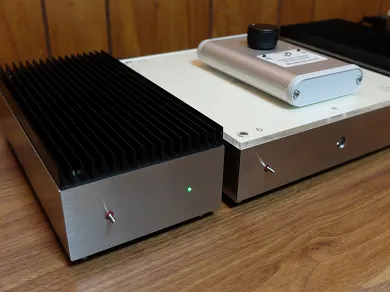
The operation is deliberately restrained. The main unit has only a power switch. Everything else is handled by the supplied remote control. Input selection is shown by coloured LEDs: red for input one, green for input two and blue for input three.
No complicated menu system. No oversized display. No unnecessary theatre.
Why Sparkler stays under the radar
Sparkler is not difficult to find because it is unimportant. It is difficult to find because it has chosen not to behave like a conventional consumer electronics brand.
There is no mass distribution strategy. No extensive advertising campaign. No chain of glossy showrooms. Production is limited, reviews are relatively rare and long lead times can be part of the experience.
Most owners discover Sparkler through word of mouth, often after hearing it in somebody else’s system.
On paper, the brand is easy to dismiss. The components are unusually small. The power rating is modest. The operation is minimal. The finish is more Japanese workshop than lifestyle electronics.
That is precisely why Sparkler deserves a proper listen.
Its products are designed for listeners who care less about impressive numbers on a specification sheet and more about the way a system behaves after an hour of listening. The goal is not to make the equipment announce itself. The goal is to let a piano, voice, string section or analogue recording occupy the room with clarity and ease.
A wider philosophy for vinyl and digital
Sparkler's philosophy extends well beyond amplification.
Sparkler's digital designs carry the same conviction. The company builds ultra-low-jitter, fully discrete clock oscillators and favours non-oversampling conversion for 16-bit CD audio, arguing that upsampling can raise clock jitter.
That is not a universal verdict on digital design, and it should not be treated as one. It is evidence of a consistent design conviction: preserve the signal, minimise unnecessary intervention and let the music retain its natural character.
At Toma Audio, that thinking is represented by the S512 "perceive" D/A processor, a compact converter designed to bring a natural, analogue-like sense of space to digital sources, and by the S515 "Ballade II" CD transport, a top-loading transport with isolated coaxial, optical and AES/EBU outputs.

The rest of the range follows the same scale and intention. The S502 "ether" is a compact 10-watt integrated amplifier with reed-switch input selection. The S505 "Flügel II" is a 25-watt power amplifier with a volume control and a pure analogue power supply.

The S506 "switchgirl" is a three-input selector built around the same ruthenium reed switch. And for the patient, two handmade full-range loudspeakers, the S301B "diva" and the S510 "flavor", complete the picture.

Sparkler's range also includes an MC/MM phono amplifier, although it is not part of our current line-up. If vinyl is your priority, just ask us and we can discuss what is possible.
The right speaker pairing is everything
The Sparkler S513i and S514i are not a universal plug-and-play recommendation. They are a carefully considered foundation for the right system.
A high-sensitivity, easy-to-drive loudspeaker is the sensible starting point. Heritage-style designs such as the Spendor Classic range can make a natural demonstration partner, depending on the room and the rest of the system.
Sparkler's own handmade loudspeakers make the same point in miniature. The compact S301B "diva" and the larger S510 "flavor" each use a single full-range driver, a deliberately simple approach that avoids a complex crossover and lets the music speak for itself.


We can also build the system around your preferred source, whether that means a carefully chosen turntable, phono stage, CD player or streamer. If you are researching the best turntables in Australia, the more important question is how the complete chain works together.
The amplifier is the foundation. The loudspeaker is the voice. The room is the instrument.
Hear the overlooked option
Sparkler Audio is not for everyone. That is part of its appeal.
It is for the listener who wants something carefully made, technically purposeful and genuinely different from the usual shortlist. It is for someone who would rather hear a beautifully balanced 25-watt system than buy an oversized amplifier based on a single number.
At Toma Audio, we can demonstrate the S513i “pastoral” and S514i “rhapsody” in a relaxed two-channel room. Bring records you know. Bring the music you return to after a long day. We will take the time to find out whether the pairing makes sense for you and your room.
You are welcome to book a listening session, email sales@toma.com.au, or visit us at the Toma Audio showroom in Tweed Heads.
No pressure. Just a proper audition of a remarkable little Japanese system.