Valve or Solid State: How to Choose the Right Amplifier for Your Speakers
You’ve picked your speakers. You have a budget. Then comes the question: glowing glass bottles or a sealed black box? The internet has strong opinions about both.
Let’s leave the tribal answers aside. The honest answer to valve amplifier vs solid state is that neither type is automatically better. Most of what listeners describe as “valve sound” or “solid state sound” comes from circuit design, output transformer behaviour, negative feedback and how the amplifier responds when pushed, not simply from the material of its amplifying devices.
The useful question is which amplifier suits your speakers, your room and the way you listen. Here’s a plain-English framework. For a broader matching guide, see How to Choose the Right Amplifier for Your Turntable and Speakers.
What a valve amplifier actually is
A valve, also called a vacuum tube, amplifies the audio signal. Valves work at high voltage and relatively low current, so a conventional valve power amplifier usually uses an output transformer to match the valves to the much lower impedance of a loudspeaker.
That transformer is part of the amplifier’s character and its design. Many valve amplifiers offer different output taps for different speaker impedances. Matching the speaker to the appropriate tap matters. Some specialist designs are output-transformerless, or OTL, but these are a different approach and not the norm.
Valve designs often use less negative feedback, which can contribute to an open, immediate presentation at moderate levels. But it is only one element in a much larger circuit.
What a solid state amplifier actually is
Solid-state amplifiers use transistors. They typically have low output impedance, no output transformer and the capacity to deliver substantial current. That can help them control a demanding speaker load. They also tend to offer more power per dollar.
There’s no valve warm-up or valve replacement to plan for, and solid-state amplifiers are usually cooler-running and lighter for the power delivered. Design still matters, of course, but for many listeners they make a straightforward, low-maintenance foundation.
The five things that actually decide it
Speaker sensitivity. Usually measured in decibels per watt at one metre, sensitivity indicates how much sound a speaker produces from a given amount of power. Many modern bookshelf and smaller floorstanding speakers sit around 85–88 dB and need meaningful power for musical peaks. Around 90 dB and above is generally easier to drive; efficient horn and heritage designs can be much higher. As a rule of thumb, a 10 dB increase in loudness needs about ten times the power. So a modest-wattage amplifier might be entirely suitable with one speaker and struggle with another. Check how the sensitivity figure was measured, too.
Impedance and its curve. A speaker’s nominal 4- or 8-ohm rating is only a summary. Its impedance changes with frequency and can dip well below that figure. A low, reactive load is often where a high-current transistor amplifier has an advantage. Transformer-coupled valve amplifiers are generally happier with a relatively stable, benign load and the correct output tap.
Room and listening distance. A nearfield setup in a small room asks less of an amplifier than speakers playing across a large open-plan living space. Add the distance between you and the speakers, and the volume you enjoy, and the power requirement changes again. A full cinema system is another challenge altogether.
Music and volume. At moderate levels, acoustic, vocal and jazz recordings can be a rewarding match for a lower-powered valve amplifier. Loud listening and dense, dynamically demanding music call for headroom: spare power for short musical peaks. When an amplifier runs out of power, it clips, or distorts the peaks of the signal. That can sound hard and fatiguing, and clipping is not something to ignore.
Ownership style. Valves are consumable. They age, may need replacement, can be microphonic, run hot and need ventilation and care. Solid state is generally more hands-off. Neither is wrong; your tolerance for the ritual and upkeep is part of the match.
How each type behaves when music gets demanding
Valve amplifiers are often described as softening or compressing more gradually as they approach their limits. Some listeners find that forgiving and musical. Solid-state amplifiers often maintain their composure, but some can sound abrupt when they clip.
These are tendencies, not guarantees. Output transformers, feedback, power supplies and protection circuits all influence overload behaviour. The complete design matters as much as the device type.
What we carry, and why
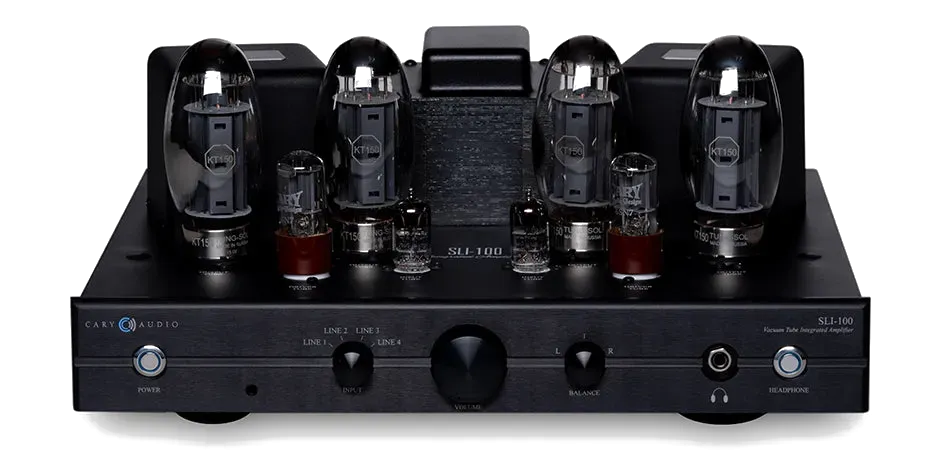
Our range offers a spectrum of approaches, not a contest. The power figures matter only alongside the speaker they are driving.
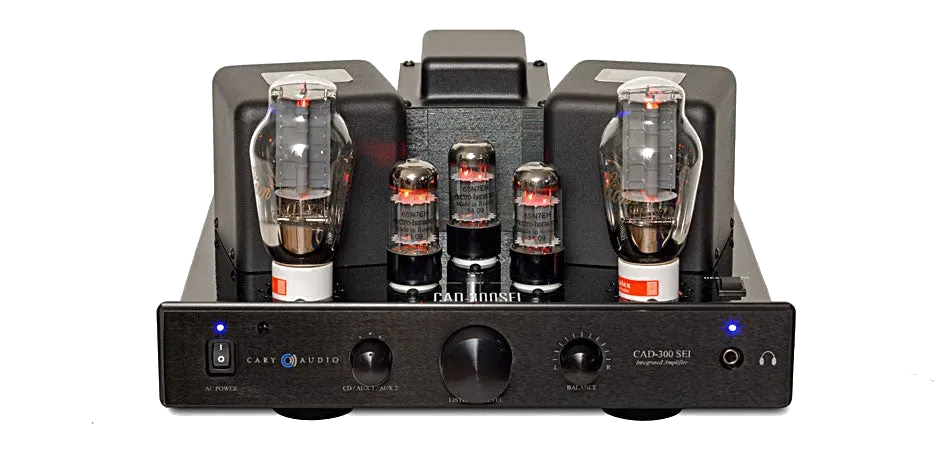
Valve and hybrid options from Cary Audio include the CAD-300SEI, a 15-watt-per-channel pure Class A single-ended triode integrated amplifier ($11,995); the SLI-80S, switchable between triode at 40 watts and ultra-linear at 80 watts per channel ($8,995); and the SLI-100, a 100-watt-per-channel Class AB1 integrated with KT150 valves ($11,995). The CAD-120S MkII stereo power amplifier offers differential-balanced circuitry and selectable triode or ultra-linear modes ($11,995). For separates, the fully differential-balanced Class A SLP-05 preamplifier has a separate power supply and built-in headphone amplifier ($18,995). The DAC-200ts offers selectable solid-state or valve analogue stages ($7,995), a useful reminder that the choice can exist within a single component.
Compact solid state from Sparkler Audio takes another route. The handmade-in-Japan S513i “pastoral” control amplifier and S514i “rhapsody” dual-monaural power amplifiers deliver 2 x 25 watts for $5,750. Their fully discrete design uses current-mode signalling. Some listeners describe the presentation as valve-like in depth, but the 25 watts make speaker sensitivity important. The S502 “ether” smart integrated delivers 10 watts ($2,180), while the S505 “Flügel II” power amplifier with volume control delivers 25 watts ($2,750). Read more about Sparkler Audio.
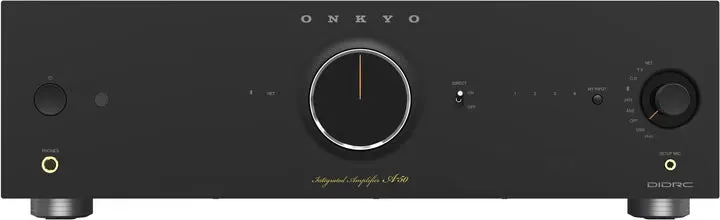
Mainstream solid-state choices span the Marantz PM6007, 45 watts per channel with built-in DAC and phono stage ($1,100), and Marantz Model 30 with MM/MC phono ($5,200); the NAD C 316BEE v2, 45 watts per channel with low-noise MM phono ($799), and C 399, 180 watts per channel with nCore and MDC2 expansion ($4,999); plus the Onkyo A-50 streaming integrated ($3,299). For more current and headroom, NAD’s C 298 uses Purifi Eigentakt technology ($4,499), while the M33 streaming amplifier delivers 200 watts per channel ($10,999).
Two illustrative scenarios
Small room, efficient standmounts, moderate listening: A 15-watt single-ended valve integrated could be a perfectly legitimate, rewarding choice, provided the speaker’s sensitivity and impedance suit it.
Large open-plan room, less efficient floorstanders, loud listening: A high-current transistor amplifier is likely the sensible direction, with power and headroom suited to the load and listening distance.
These are examples, not guaranteed pairings. The speaker’s full specifications and an audition help settle the question.
If you also run vinyl
Whichever amplifier topology you choose, the phono stage is the next decision. It can be a significant upgrade for a vinyl system, and a valve phono stage is one of the more seductive ways to explore a warmer analogue presentation. If you’re comparing the best turntables Australia has to offer, remember that the cartridge and phono stage are part of the same chain. The Hidden Hero of Vinyl: Why Your Phono Stage Shapes the Sound of the Best Turntables in Australia explains more.
We can demonstrate a turntable through both valve and solid-state systems on the same speakers, so you can hear the difference in context.
If you also run a cinema system
A valve amplifier is not the right tool for powering a seven-channel cinema array. But sharing a room between a two-channel valve system and a home cinema is entirely practical. With a compatible cinema-bypass path, the stereo amplifier can drive the front speakers for music, while the cinema processor or receiver takes over for films. It’s a useful consideration when planning a home theatre installation Gold Coast homeowners can enjoy for both music and movies. See The Best of Both Worlds: How to Master Home Theatre with Cinema Bypass.
How to decide in ten minutes
- Audition valves if your speakers are efficient and stable, you listen at moderate levels, and you enjoy warmth, immediacy and the ritual of ownership.
- Audition solid state if your speakers are less efficient or present a difficult load, you listen loud, or you want low maintenance and power for your budget.
- If you’re unsure, you’re in the normal majority. That’s precisely why we keep both approaches on the floor.
Bring your speakers, if practical, or tell us what you own. At our relaxed Tweed Heads showroom, we can run the same speaker on valve and solid-state amplifiers back to back. We welcome music lovers from the Gold Coast, South-East Queensland and Northern Rivers.
Book a listening session and audition the experience. We’ll match the amplifier to your system, not just to a specification. Sound advice for a sound investment.