

Home Theatre Installation Gold Coast: What It Really Costs in 2026 (And Where to Splurge)
Planning a home theatre installation on the Gold Coast is exciting. It is also easy to underestimate the real cost.
You may begin with a television, soundbar or projector in mind. Then the quote expands to include brackets, cabling, speaker placement, network configuration, acoustic treatment and calibration. Suddenly, the “simple” weekend project is anything but simple.
We’ve all been there. You invest in impressive equipment, press play, and discover that dialogue is muddy, bass is booming and the cables are still visible. The ultimate mood killer.
The good news? A great home theatre does not need to be extravagant. It needs to be intelligently planned.
Below is a realistic 2026 Australian pricing guide, including where to save, where to splurge and why the lowest quote is not always the best solution.
Important: These are indicative installation allowances, not fixed quotes. Final pricing depends on your room, wall construction, cable access, equipment and the level of integration required.
The 2026 home theatre installation cost guide
Professional audio-visual labour commonly sits around $100–$250 per hour in Australia in 2026. Specialist design, integration and calibration services generally sit at the upper end of that range because you are paying for experience, testing and accountability, not simply time on a clock.
Here are the most useful planning figures.
| Installation or project | Indicative 2026 cost |
|---|---|
| TV wall mounting | $100–$300 |
| Soundbar installation | $150–$350 |
| Straightforward 5.1 surround setup | $300–$700 |
| More involved 5.1 or 7.1 installation | $800–$2,000+ |
| Projector and screen installation | $300–$1,000+ |
| Dedicated theatre room fit-out | $3,000–$30,000+ |
These figures generally refer to installation, configuration and associated labour. Equipment is usually additional.
For comparison, current Australian installation guides from hipages and local service providers such as Comms-X show how much the scope can change between a basic mount and a fully integrated cinema.
1. TV wall mounting: $100–$300
A basic TV wall mount is usually the most affordable entry point. For a standard-sized television on a straightforward plasterboard or masonry wall, you can expect to budget approximately $100–$300.
The final cost may increase if you require:
- A premium tilt or full-motion bracket.
- A large or particularly heavy television.
- Concealed power and HDMI cabling.
- Mounting above a fireplace or inside custom cabinetry.
- Masonry drilling or difficult access.
- Connection of multiple sources, such as a games console, set-top box and Blu-ray player.
A clean installation is about more than getting the screen on the wall. The correct viewing height, cable path and ventilation all matter. A television mounted too high can leave you with neck strain. A poorly planned cable route can compromise the entire appearance of the room.
The screen is the visual centrepiece. Its installation should feel intentional.
2. Soundbar installation: $150–$350
A soundbar is a sensible solution for a compact lounge, apartment or open-plan living area where a full speaker package is not practical.
Professional soundbar installation typically costs $150–$350, depending on whether it is wall-mounted, connected to a television and subwoofer, or integrated with an existing network.
The extra value of professional setup is often found in the details:
- Correct soundbar height and angle.
- Secure wall mounting.
- Hidden cables.
- HDMI ARC or eARC configuration.
- Subwoofer placement.
- TV and soundbar power synchronisation.
- Network connection and streaming setup.
A soundbar can be excellent when matched to the room. It can also sound underwhelming if placed inside a cabinet, positioned too low or connected through the wrong input.
3. Surround sound installation: $300–$2,000+
This is where the range becomes wider.
A basic 5.1 system with accessible cable paths may begin around $300–$700 for installation. A more involved 5.1 or 7.1 system with concealed cabling, wall or ceiling speakers and receiver configuration can reasonably reach $800–$2,000 or more.
The cost is influenced by:
- Number of speakers.
- In-wall or in-ceiling cable runs.
- Wall and ceiling construction.
- Distance between the AV receiver and speakers.
- Whether speakers are being mounted or recessed.
- Subwoofer positioning and integration.
- Receiver setup and acoustic calibration.
- Whether the system includes Dolby Atmos height channels.
A 5.1 system has five main channels and a subwoofer. A 7.1 system adds two further surround channels. Dolby Atmos systems add height information, creating a more enveloping sound field.
In plain English, the more carefully the system is positioned and tuned, the more convincingly sound moves around you.

4. Projector and screen installation: $300–$1,000+
A projector can deliver a genuinely cinematic image, particularly in a dedicated room or large media space. Installation generally starts around $300 for a relatively simple ceiling-mounted projector and can exceed $1,000 when a screen, concealed cabling and control integration are included.
You may need to allow for:
- Projector ceiling bracket.
- Motorised or fixed-frame screen.
- Long HDMI or fibre-optic cable runs.
- Ceiling reinforcement.
- Power at the projector location.
- Screen housing or recessed installation.
- Lens alignment and image calibration.
- Lighting control and blackout solutions.
A projector is not automatically the better choice. In a bright Gold Coast living room with floor-to-ceiling glass, a large television may provide a more consistent daytime picture. In a controlled room, however, a projector and screen can transform a film night into something far more immersive.
This is a decision best made after considering the room, not just the size of the image.
5. A dedicated theatre room fit-out: $3,000–$30,000+
A dedicated theatre room is a different category altogether.
A modest fit-out may cost $3,000–$8,000, while a more comprehensive project can sit between $10,000 and $30,000+. That may include installation labour, cabling, acoustic treatment, lighting, seating preparation and control integration. Equipment is often additional.
At the premium end, room construction and architectural work can take the budget considerably higher.
Typical fit-out considerations include:
-
Cabling infrastructure
Speaker cables, HDMI, Ethernet and power should be planned before walls and ceilings are closed. This invisible backbone is difficult and expensive to retrofit later. -
Acoustic treatment
Absorption and diffusion help control reflections, bass build-up and unwanted echo. Your room is effectively the largest speaker in the system. -
Lighting control
Dimmable, scene-based lighting adds comfort and atmosphere. One button can take you from “welcome” to “film”. -
Ventilation and equipment location
Projectors, amplifiers and AV receivers generate heat. A tidy equipment rack needs airflow. -
Seating and sightlines
The best picture and sound are wasted if your seating position is wrong. -
Calibration
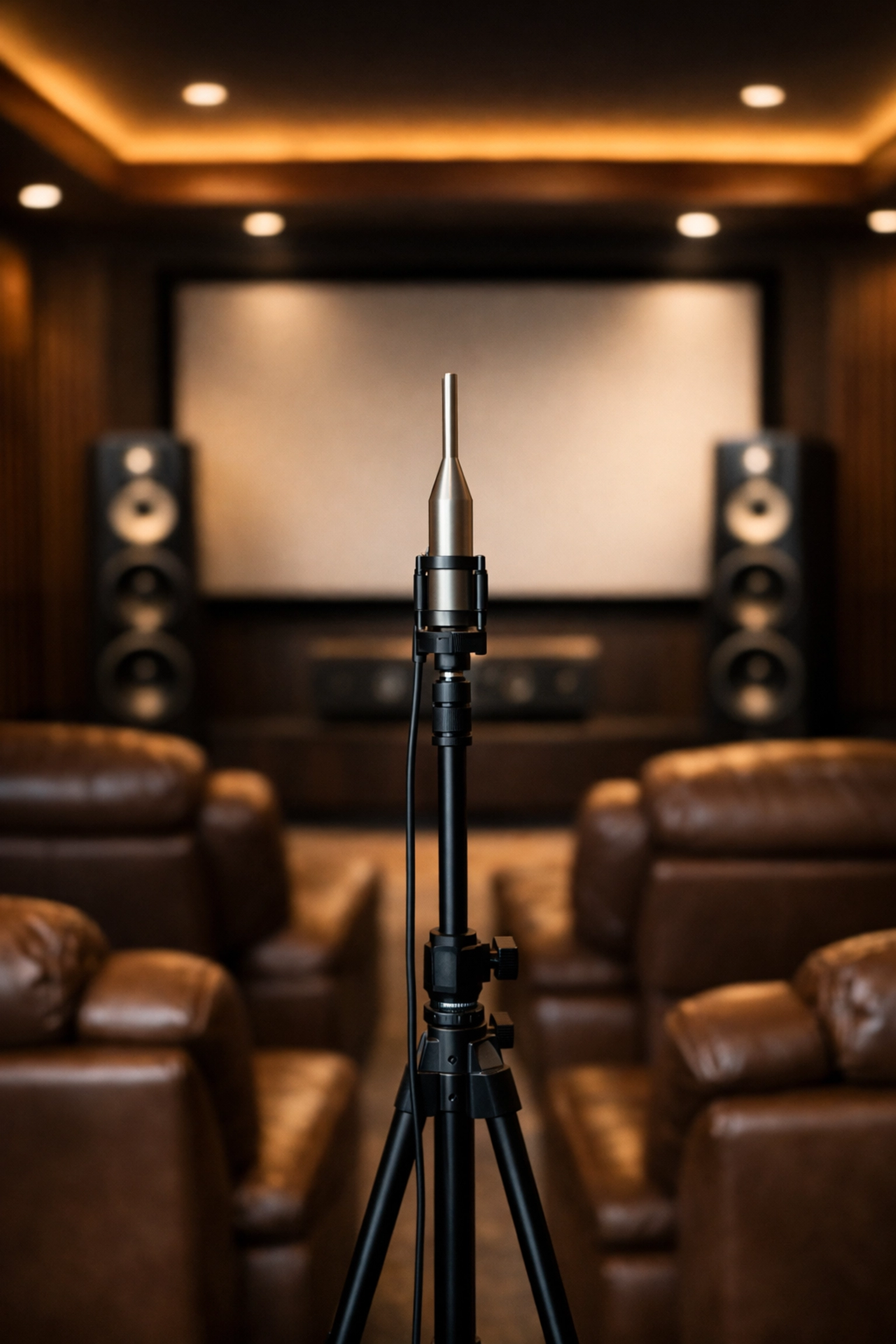
Acoustic calibration measures how the room interacts with your speakers and adjusts timing, levels and tonal balance. The benefit is simple: tighter bass, clearer dialogue and a more coherent surround field.
Toma Audio has written more about this in Why Professional Calibration Is the Secret to the Perfect Home Cinema.
Where should you splurge?
A considered budget does not mean spending everywhere. It means investing in the parts that most affect your experience.
1. Splurge on the front soundstage
The centre speaker carries much of a film’s dialogue. It should be clear, articulate and properly matched to the left and right channels.
If your budget is limited, prioritise the front three speakers before adding extra effects channels. A convincing front soundstage will make a modest system feel sophisticated.
2. Do not underestimate the subwoofer
Bass is not just about volume. It is about depth, timing and control.
A quality subwoofer, correctly positioned and integrated, gives explosions weight without making the room sound bloated. In larger spaces, dual subwoofers can produce more even bass from different seating positions.
3. Spend on planning and cabling
Cabling is not glamorous. It is the heavy-lifting copper backbone that keeps the system reliable.
Use suitable speaker cable, plan HDMI requirements carefully and allow for future upgrades. A professional installer can identify cable routes, network requirements and power needs before they become expensive building changes.
Toma Audio’s guide to proper networking explains why reliable connectivity matters. Streaming, multi-room audio and home automation all depend on a stable foundation.
4. Make room correction part of the budget
A premium system left uncalibrated may perform below its potential. Professional calibration can address timing, phase, speaker levels and room response.
That is particularly important in Gold Coast homes with tiles, glass, open-plan layouts and high ceilings. These surfaces look beautiful, but they can create reflections that make sound bright, harsh or indistinct.
5. Choose value-focused speakers intelligently
Klipsch speakers are often a smart value choice for cinema sound. Their horn-loaded design delivers high efficiency, dynamic impact and strong dialogue presence without demanding enormous amplifier power.

The Klipsch Heritage Series brings a warm, analogue soul and furniture-quality timber finishes. For a more discreet, modern cinema, Klipsch Reference Premiere models are designed around multi-channel and Dolby Atmos applications.
The right choice depends on your room and priorities. We listen first.
Why the lowest quote is not always the best solution
Two quotes can look similar while offering very different outcomes.
One may include only basic mounting. Another may include a site assessment, concealed cabling, equipment configuration, network setup, calibration and aftercare.
Before comparing prices, ask:
- Is equipment included?
- Are brackets and cables included?
- How many cable runs are allowed?
- Is wall or ceiling repair included?
- Will the system be calibrated?
- Who handles difficult access or unexpected site conditions?
- Is the network configured for streaming?
- What support is available after installation?
A cheap installation that leaves you with unreliable connections, visible cabling or poor sound is not a saving. It is a deferred cost.
A bespoke home theatre starts with a conversation
Whether you are furnishing an apartment in Broadbeach, renovating in Burleigh or building a dedicated room near Sanctuary Cove, your home theatre should suit your lifestyle.
At Toma Audio, we provide personalised advice rather than a one-size-fits-all package. We can design a discreet system for a compact lounge or a high-performance cinema for a dedicated room. We work with traditional formats, modern streaming and complete home entertainment integration.
Most importantly, you can audition equipment in our relaxed Gold Coast showroom. Hear the difference between speaker designs. Experience the authority of a properly integrated subwoofer. Compare a soundbar with a full surround system.
Reading about sound only tells you half the story.
If you are considering a home theatre installation on the Gold Coast, visit our contact page or come into the showroom for a consultation and audition.
No pressure. Just sound advice for a sound investment.